

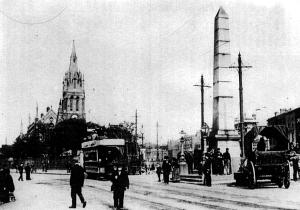
St John's c.1910
The docks area and the railway yards, some of the largest in the country at the time, made East and West Ham prime targets for German Zeppelins in World War 1 and also German bombers in World War 2: during the Blitz West Ham was raided 194 times, losing 1207 dead and one third of its houses. Many hundreds of people took shelter night after night in the crypt of St John's. The building was badly damaged by bombing: in particular all the windows were blown out. The only pre-war window is the small window in the Chancel which is a copy of the famous picture by Holman Hunt "The Light of the World" (external link). This was taken out and stored before the bombing. The churchyard railings were also removed for the war effort.
The Friends of St John's was formed in 1944 to keep members who had been bombed out of the East End in touch with each other. After the War St John's went in to a bit of a decline. Many of the faithful members had been bombed out, others moved out as a result of demolition and new developments. The Friends contributed towards the cost of repairs and St John's was finally restored from war damage in 1951, the new East Window being dedicated in 1955.
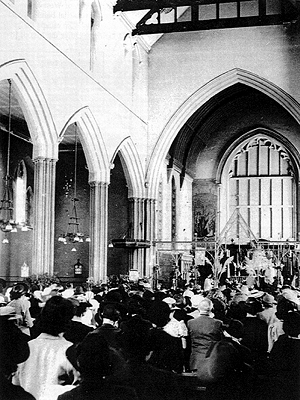
A service at St John's in the 1940s,
showing the windows boarded up because of bomb damage.
Redevelopment of the area was slow; the famous pre-fabs appeared along the Romford Road; in 1953 the River Thames flooded; tower blocks appeared. The 1960s saw the redevelopment of an authentic East End street market, Angel Lane, into a shopping mall.
1961 saw the Parish of Christ Church, Stratford Marsh, re-united with St John's, the church buildings stood empty until they were eventually demolished in 1975.
In 1965 West Ham and East Ham were combined to form the Borough of Newham. Governments began to recognise their neglect of the areas which had suffered in the Blitz and plans began to redevelop the area. Unfortunately, by the 1970s the congregation of St John's was quite small, the building was in poor structural condition, the doors were locked except for Sundays and there was even talk of closure.
Things started to change however. A new Freight Terminal opened on the derelict areas of the vast Railway Engineering Yards, then a new Rail Station and a new Bus Station; new rail routes linked the East End with the City and the new Docklands Development. The 1960s Mall was redeveloped, as was the area around The Theatre Royal, a famous East End venue for many celebrities and home of Joan Littlewood. An Arts complex was designed for the area. A new set of Municipal Offices (known locally as 'The Pyramid') was built in the Grove. The old North East London Polytechnic achieved University status. A new General Hospital was built in Plaistow in 1983. A year later the Thames Barrier opened to prevent a recurrence of the 1953 disaster. The Gas and Sewage plants in Beckton gave way to a new town along Newham Way near the new City Airport.
St John's congregations started to increase. A new extension was built at St John's in 1998 to provide facilities for the church members and the local community. The bricks used to build the extension were recycled from a demolished building and came from the original brickyard and the same period as when the church was first built. (the architects for the new extension were Purcell Miller Tritton (external link))