

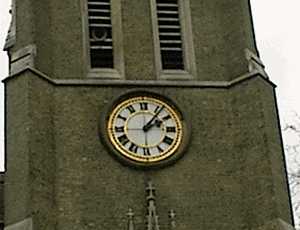
St John's clock was built by Benjamin Lewis Vulliamy in 1834. Vulliamy came from a noted clock making family, and he was himself an eminent and respected maker. Admitted to the Clockmakers' Company in 1809, he served as Warden from 1821 to 1825. He also held the appointment as clock maker to the King. He built clocks in Canada and Australia as well as in England which include those at Hampton Court, Oriel College Oxford, Windsor Castle and Plymouth Dockyard. Turret clocks, of which St John's is an example, only represent one aspect of his work.
The British Horological Institute library holds a printed pamphlet entitled 'Testimonials respecting Clocks made by B.L. Vulliamy', published in 1837. It includes testimonials relating to three turret clocks, including that of St John's, and one domestic clock. Below is an extract from the entry for St John's.
STRATFORD, Essex, St John's Church: testimonial dated 12 July 1836 from W. Davis, Leytonstone - "Our Clock has now been going at least two years, I believe, without the slightest deviation as to time." ... not cheap ... may be depended on. Testimonial dated 5 July 1836 from Hugh C. Jones, Stratford Green (Vicar of West Ham) - not yet met an individual not pleased with it; Mr. Vulliamy selected from list of seven competitors; accuracy carefully observed. Testimonial dated 4 July 1836 from A. Lancaster, Stratford: clock "placed in tower of new church January last"; since pendulum adjusted, in six weeks never altered and varied (lost) five seconds on Greenwich.
The tower also contains three bells, the two smaller of which were connected to the clock. All three bells were cast by Mears of London, which company later became The Whitechapel Bell Foundry, in 1835. The Church Bells Of Essex by The Rev. Cecil Deedes & H. B. Walters published in 1909, contains this entry for St. John's:
HAM, WEST. Stratford, St. John. Three bells.
1. THOMAS MEARS OF LONDON FECIT 1835 (24 in.
2. THOMAS MEARS OF LONDON FECIT 1835 (29 in.
3. THOMAS MEARS OF LONDON FECIT 1835 (36 in.
Lettering on 1st very small, except the initials, which are ordinary size.
Whilst the bells are still in good condition, and voice, despite years of neglect, they will, unfortunately, never again be heard striking out the hours or ringing for the call to Sunday services as the frames in which they are housed, and the tower itself, would not be able to stand against the vibrations they would set up.